Error
текст ошибки


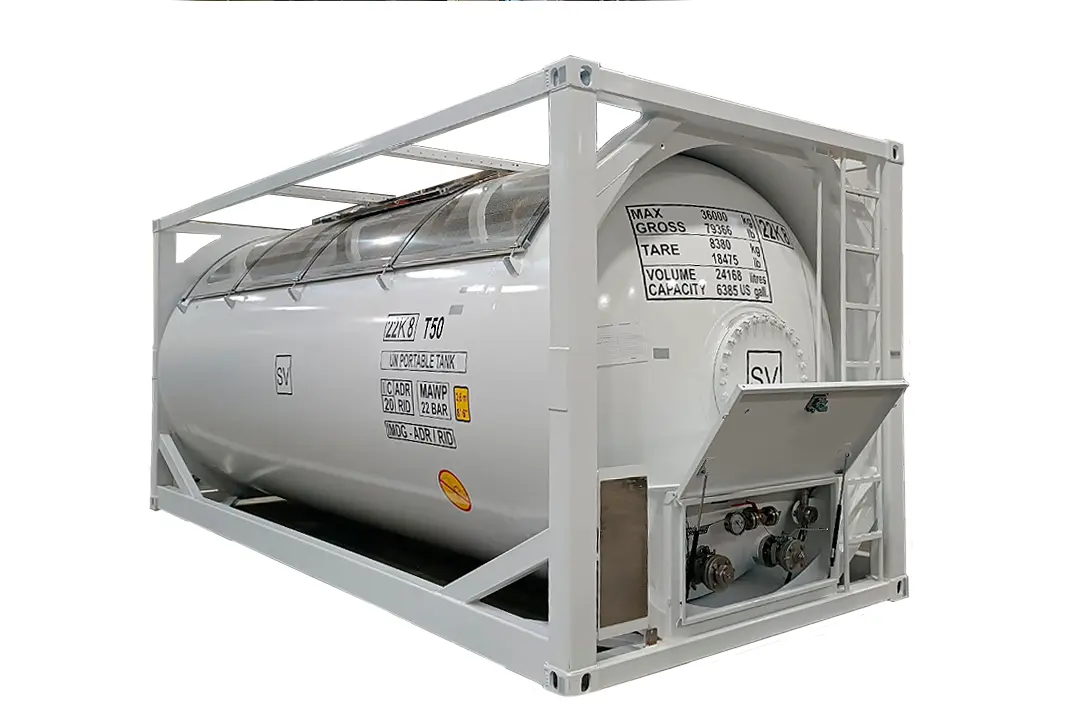
Tank container C50L25/22RS
The 24,500-litre T50 C50L25/22RS tank container is designed for non-refrigerated liquefied petroleum gases and anhydrous ammonia UN 1005. Maximum working pressure is 2.2 MPa (22 bar). It has separate liquid and vapour lines, a sunshield and product parameter monitoring.
About the product
- TypeT50
- Volume24,500 l
- Dimensions to ISO 668:2020, 1CC (20 ft)6058x2438x2591 mm
- Tank container tare weight8650 kg±2%
- Maximum gross weight36000 kg
- Maximum payload27350 kg
- Operating pressure, MPa2.2
- Test pressure, MPa3.03
- Operating temperature range-40℃ ... +50℃
- ApplicationLiquefied petroleum gases; anhydrous ammonia UN 1005
- ManufacturerSespel
- Head and shell materialP355NL2 EN 10028-3:2017
Contact us for more information about this product.
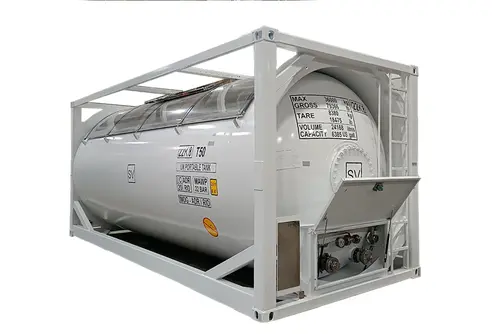 Tank container C50L25/22RS
Error
Description
C50L25/22RS is a 24,500-litre T50 tank container for non-refrigerated liquefied petroleum gases and anhydrous ammonia UN 1005. Cargo is transported under pressure; the vessel maximum working pressure is 2.2 MPa (22 bar). The twenty-foot envelope accommodates the vessel, two transfer lines, safety fittings and product measurement instruments.
Gases covered by the /22RS version
The manual lists anhydrous ammonia UN 1005, propane UN 1978, butane UN 1011, propylene UN 1077 and other non-refrigerated liquefied gases. Specify the exact product, UN number and mixture composition when ordering so fittings, seals and filling conditions can be agreed. The /22RS documents do not automatically establish the same approvals for C50L25/18RS.
This T50 version must not be confused with T75 cryogenic tanks. It uses a pressure vessel for non-refrigerated liquefied gas; the sunshield does not turn it into a refrigeration system. Tank container selection depends on the cargo state and transport conditions.
Separate liquid and vapour connections
Separate liquid and vapour transfer assemblies are provided at the bottom. The liquid line transfers product during filling and emptying, while the vapour line connects the vessel gas space to the appropriate terminal equipment. This distinction matters when selecting hoses, connections and transfer arrangements; the lines are not interchangeable.
The lower rear equipment compartment protects the transfer fittings and provides for locking and security sealing. The specifications describe a separately operated cable system for remotely closing quick-closing protective valves in an emergency. Its provision and arrangement must be checked against the supplied container configuration and fitting documentation.
P355NL2 vessel and twenty-foot frame
The welded vessel consists of a cylindrical shell and two elliptical heads made of P355NL2 steel to EN 10028-3:2017, with flanges for equipment installation. Support rings connect the vessel to the end frames, which are linked by longitudinal beams. Corner fittings support handling, vehicle securing and stacking.
A ladder with non-slip steps and a decked platform provide access to the top equipment. The DN500 manway is at the rear centre of the head and is intended for inspection, cleaning, examination and repair. The specifications do not permit using the service manway in place of the transfer line. The frame has earthing points for cargo handling.
Sunshield and cargo monitoring
The steel shield above the vessel reduces direct solar exposure of its surface. It is passive protection and does not maintain a set temperature. Cargo parameters are therefore monitored by instruments: the manual specifies a magnetic float level and temperature transducer and a pressure gauge.
Level, temperature and pressure describe different aspects of product condition. A level reading helps assess filling but does not replace checks of permissible cargo mass and density. The gauge scale range is not the tank container permissible working pressure either. Instruments and connections must be checked against the specification.
Valve with rupture disc and pressure parameters
The protective assembly includes a spring-loaded safety valve, rupture disc and monitoring gauge. Disc condition and valve operation are checked against the assembly documentation. Safety fitting settings must not be inferred solely from vessel test pressure or transferred from another tank container version.
- Geometric capacity24,500 litres
- Internal working pressure2.2 MPa (22 bar)
- Design internal pressure2.33 MPa
- Vessel test pressure3.03 MPa
- Tare weight according to the manual8,650 kg ±2%
- Maximum gross weight36,000 kg
- 1CC dimensions6,058 × 2,438 × 2,591 mm
The 2.2 MPa working pressure, 2.33 MPa design pressure and 3.03 MPa test pressure describe different vessel parameters. A strength test does not authorise transport at test pressure. The manual specifies an ambient range of −40 to +50 °C; conditions for the gas itself must be checked against the product and container documentation.
Why capacity does not determine every load mass
The 24,500-litre geometric capacity does not permit complete filling with any gas. Loading must account for product density and thermal expansion, allowable filling ratio, actual tare and the 36,000 kg gross-mass limit. Density examples in the manual apply to their stated conditions and do not replace load selection for a specific LPG composition or ammonia.
C50L25/22RS documents
| C50L25RS-0.0000-02РЭ | C50L25/22RS operating manual | Open | Unknown |
Certificates
| 22.47.01.00222.382 | CSC | Open | Unknown | |
| 2.3.4 22.47.01.00224.382 | Design type approval | Open | Unknown | |
| 2.4.2 22.47.01.00223.382 | Customs Convention on Containers | Open | Unknown |
Compatible fittings
Frequently asked questions
Answers to questions about selecting, connecting and operating the product.
Is C50L25/22RS suitable for anhydrous ammonia?
Anhydrous ammonia UN 1005 is listed in the manual for this version. Valves, seals and filling conditions are matched to the particular cargo.
Does this tank require cryogenic refrigeration?
C50L25/22RS is a T50 tank for non-refrigerated liquefied gases under pressure. Refrigerated cryogenic cargoes use separate T75 versions.
Why is there a separate vapour line?
It connects the vapour space separately from the liquid line. The operating arrangement is matched to the loading or unloading facility.
Do /22RS and /18RS have the same approvals?
They must not be assumed identical. The manuals supplied for this update cover /22RS; /18RS requires its own pressure rating, cargo list and documentation.