Error
текст ошибки


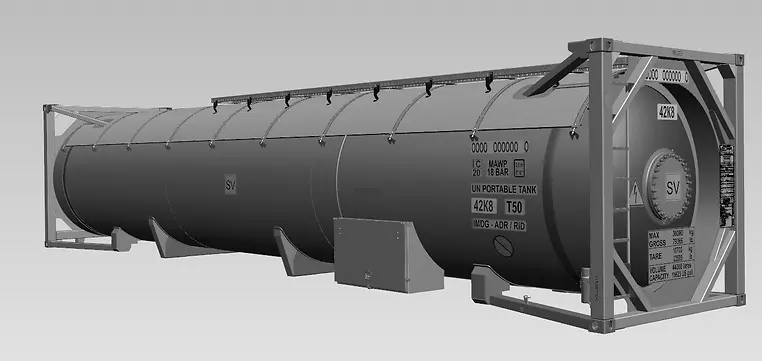
Tank container C50D44/18-01RS
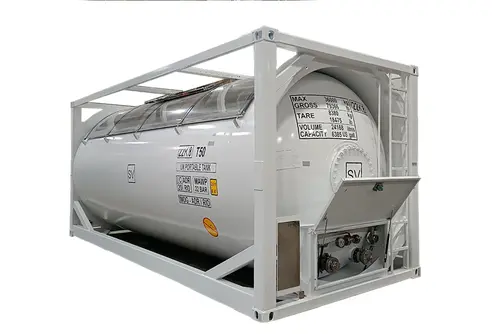
C50D44/18-01RS is a T50 tank container with a capacity of 44,000 litres in a 18 bar version. It is intended for non-refrigerated liquefied gases; selection for LPG requires checking the specific cargo approval and safety fittings.
About the product
- TypeT50
- Volume44,000 l
- Dimensions to ISO 668:2020, 1AA (40 ft)12192x2438x2591 mm
- Tank container tare weight10700 kg
- Maximum gross weight36000 kg
- Maximum payload25300 kg
- Operating pressure, MPa1.8
- Test pressure, MPa2.59
- Operating temperature range-40℃ ... +50℃
- ApplicationLiquefied gas under pressure
- ManufacturerSespel
- Head and shell materialP355NL2 EN 10028-3
Contact us for more information about this product.
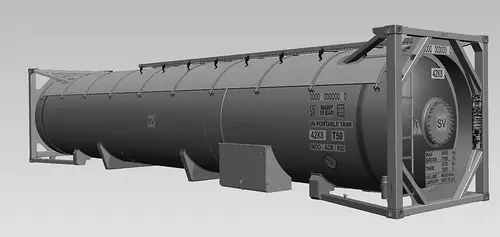 Tank container C50D44/18-01RS
Error
Description
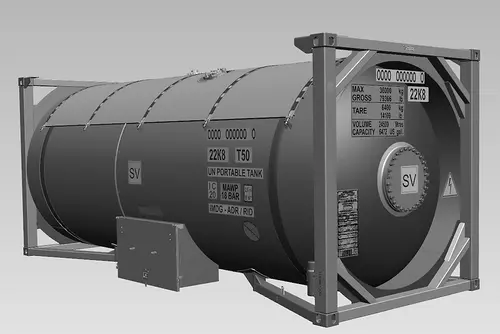
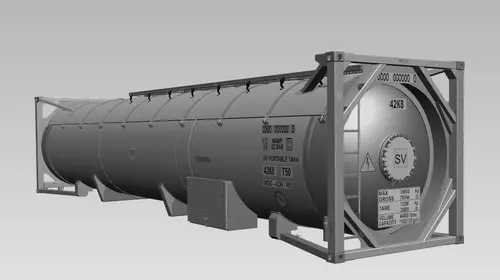
C50D44/18-01RS is a forty-foot T50 tank container with a capacity of 44,000 litres for non-refrigerated liquefied gases. Maximum working pressure is 1.8 MPa (18 bar). It is intended for road, rail and sea transport, transfer operations and temporary storage. The baffled vessel is mounted in a frame with contact pads and a gooseneck tunnel.
44,000 litres: vessel and load distribution
The shell and two elliptical heads are made of P355NL2 steel to EN 10028-3. Internal baffles divide the volume into sections no larger than 7,500 litres. They limit liquid movement during transport; the sections are not separate tanks for different cargoes. Process equipment mounts on the vessel flanges.
The welded 09G2S steel frame includes support rings, reinforcements and intermediate supports. Contact pads transmit loads to the vehicle, while a recessed tunnel in the base accommodates a gooseneck chassis arrangement. Corner fittings support handling, securing and stacking. Container dimensions are 12,192 × 2,438 × 2,591 mm.
Separate liquid and vapour fittings
The manual diagram shows two independent lines. The liquid line has an internal valve, ball valve and transfer connection; the vapour line has its own internal valve, ball valve and connection. The liquid line transfers product, while the vapour line connects the gas space to site equipment. These functions must be considered when selecting hoses and agreeing the connection arrangement.
Transfer fittings are housed in an equipment box that protects them from mechanical impacts. The box also contains the pressure gauge and level indicator. The separate gauge line has a shut-off valve and a verification connection. This arrangement distinguishes cargo connections from monitoring equipment and their respective functions.
Protection for the 18 bar version
The LPG version shown uses a 09267 safety valve set to 18 bar. It operates mechanically under medium pressure. The 09268 device set to 22 bar with a rupture disc belongs to a different version and is not a substitute merely because its bore matches. The safety fittings must be checked against the individual tank container passport.
The manual distinguishes 1.8 MPa working pressure, 1.99 MPa design internal pressure and 2.59 MPa strength test pressure. These parameters are not interchangeable: passing a test does not authorise transport at test pressure. Valve settings and operation must be checked against the installed equipment documentation.
Sunshield and product measurement
The sunshield reduces direct solar exposure of the vessel. It is not a refrigeration unit and does not maintain a set temperature. Safety fittings and a magnetic float level and temperature transducer are mounted on top of the container. Readings are transmitted to the indicator in the equipment box.
Level, temperature and pressure monitoring complements checks of loading conditions. Level alone does not establish the permissible mass of a particular gas, and the gauge scale range does not define vessel pressure limits. The manual requires attention to instrument condition, seals and verification dates.
Cargo mass depends on more than capacity
- Geometric capacity44,000 litres
- Tare weight according to the manual10,700 kg
- Maximum gross weight36,000 kg
- Internal working pressure1.8 MPa (18 bar)
- Design internal pressure1.99 MPa
- Vessel test pressure2.59 MPa
- Ambient temperature−40 to +50 °C
The difference between gross mass and the stated tare is 25,300 kg. This is a mass limit, not authorisation to load that amount of every product. Permissible filling ratio, density and thermal expansion must be considered for each gas. The manual provides for a plate listing approved non-refrigerated liquefied gases and the maximum permitted mass of each.
For LPG selection, specify the exact product composition and UN number. Approvals for the 22 bar ammonia version must not be automatically transferred to C50D44/18-01RS. Neither the 44,000-litre geometric capacity nor the T50 designation replaces checking the specific cargo against the container documentation.
Service access
A ladder and top platform provide access to vessel-mounted equipment. The DN500 end manway is intended for inspection, cleaning, repair and examination. The frame provides an earthing connection and a document holder. Maintenance includes checking the vessel and load-bearing frame as well as fitting tightness.
C50D44/18-01RS documents
| C50D44RS-0.0000-01РЭ | C50D44/18-01RS operating manual | Open | Unknown |
Compatible fittings
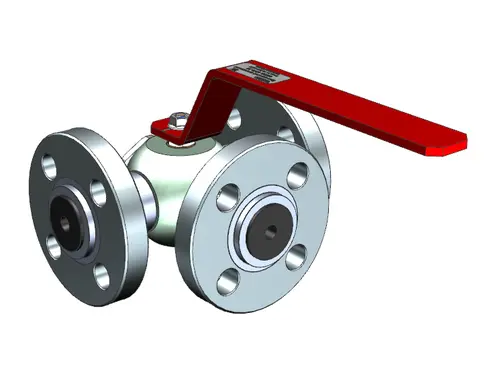
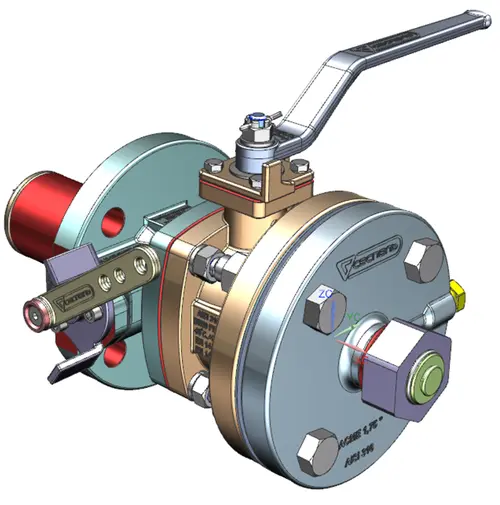
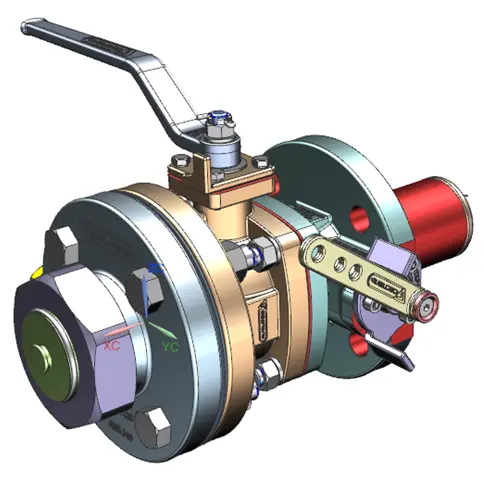
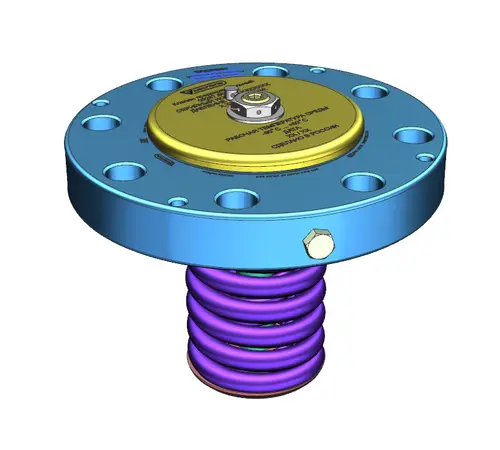
Frequently asked questions
Answers to questions about selecting and configuring a tank container.
What is C50D44/18-01RS designed for?
C50D44/18-01RS is a T50 tank container with a capacity of 44,000 litres in a 18 bar version. It is intended for non-refrigerated liquefied gases; selection for LPG requires checking the specific cargo approval and safety fittings.
Liquid and vapour phases: what matters?
The transfer arrangement handles the liquid and vapour phases separately. The lines serve different purposes: specification requires checking the connection layout, interfaces and seal compatibility with the cargo.
Safety fittings version: what should be checked before ordering?
LPG tank containers use the 09267 relief valve set to 18 bar. The 09268 device set to 22 bar with a bursting disc belongs to a different version. Equal nominal bore does not make these devices interchangeable.
Can the load be determined from capacity alone?
No. Product density and condition, permitted filling level and the individual container gross weight must be checked. Geometric capacity describes vessel volume, not a universal cargo mass.