Error
текст ошибки


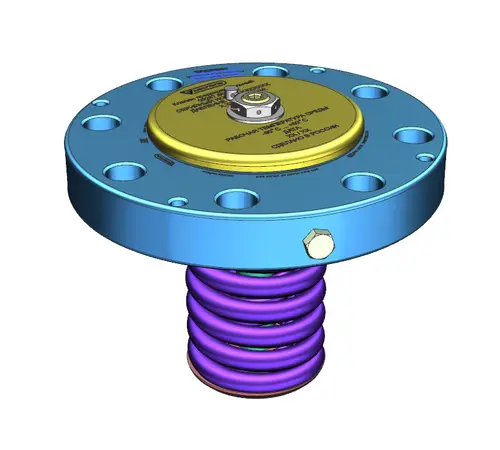
Safety valve 09267.8018.31
About the product
- VersionFor tank containers; not for road tankers
- Nominal boreDN 80
- WeightUp to 30.5 kg
- Working mediumLPG — tank container version
- Body material12Kh18N10T, GOST 5632-2014
- Disc sealF4PN PTFE, GOST 10007-80
- Nominal pressure PN38.5 bar
- Set pressure18 bar (1.8 MPa)
- Body test pressure57.75 bar (5.775 MPa)
- Working medium temperature−60 to +80 °C
- Climatic versionV1 (−60 to +50 °C)
- Type09267.8018.31
- ManufacturerSespel
Contact us for more information about this product.
Safety valve 09267.8018.31Error
Description
The 09267.8018.31 safety valve protects liquefied petroleum gas tank containers against overpressure. This DN80 spring-loaded device is set to 18 bar: it releases medium as pressure rises, then closes and stops discharge once safe conditions are restored. This version is tank container equipment and is not intended for road tankers.
How pressure opens the valve
When closed, the valve disc is pressed against its seat by a large and a small spring. Medium pressure from the inlet acts on the disc in the opposite direction. Once this force overcomes the springs, the disc lifts from the seat to open the discharge path. The manual describes proportional action: lift increases as pressure rises above the threshold.
After pressure falls, the springs return the disc to its seat. This cycle requires no electrical supply, sensor-controlled actuator or external control command. The valve operates directly under medium pressure as a protective device, rather than a routine pressure regulator for the container.
Spring assembly, guide and seal
The stem moves within an F4PN PTFE guide bush. The large and small springs are made of AISI 302 stainless spring steel and transmit their force through spring supports. The disc design prevents rotation caused by pulsation and vibration while open. An F4PN PTFE disc gasket provides sealing when the disc returns to its seat.
Spring force is set by an adjusting nut; the setting is locked with a screw and secured by a sealing cable and clamp. Seal integrity is checked before installation and during inspections. The top protective cap prevents water from collecting on the outlet side, where freezing could impair valve operation.
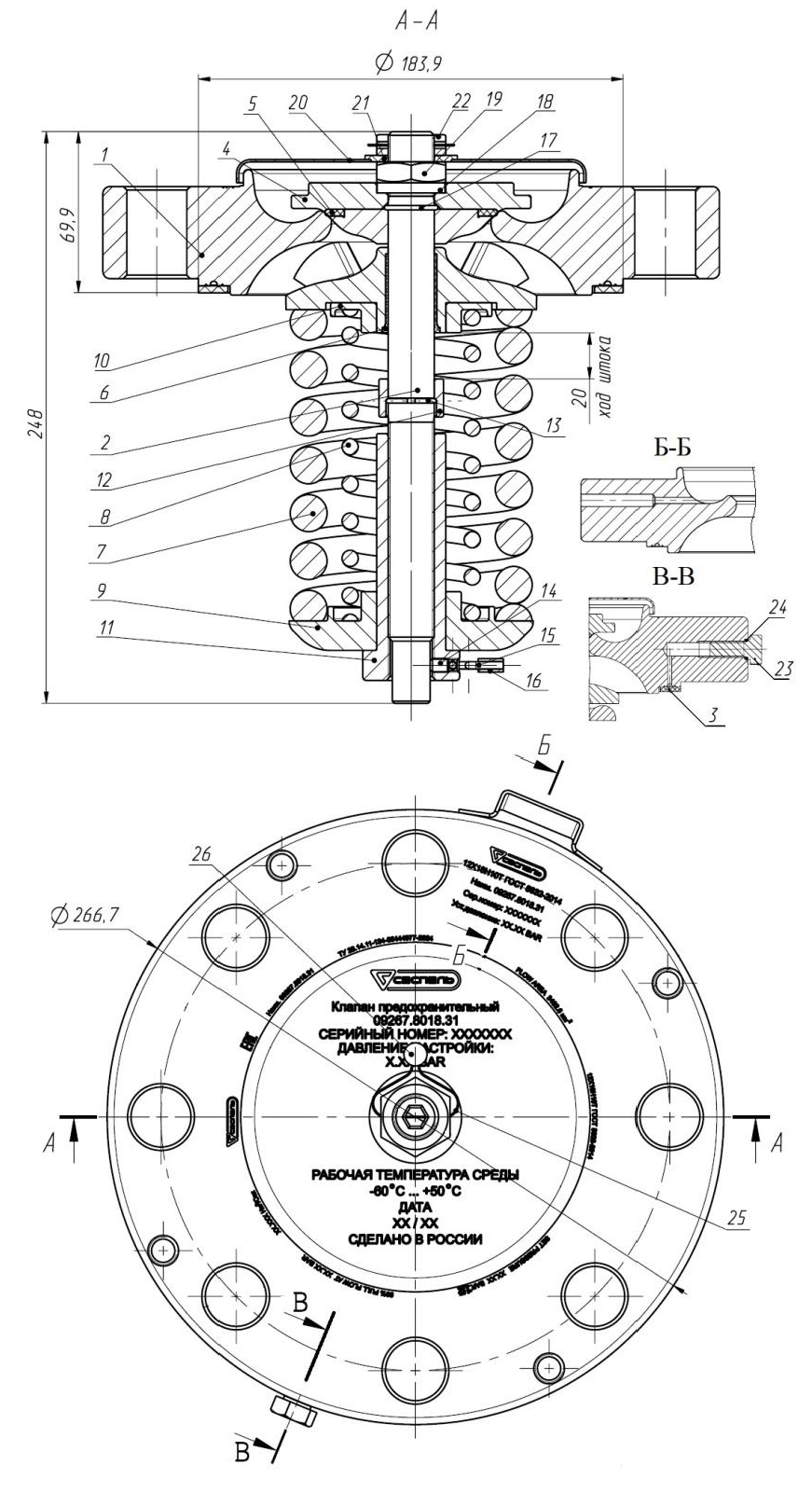
09267 valve cross-section, general view and connection — Figure 1 from the operating manual
18 bar setting and other specifications
- Set pressure18 bar (1.8 MPa)
- Nominal pressure PN38.5 bar
- Body test pressure57.75 bar (5.775 MPa)
- Nominal boreDN 80
- Body material12Kh18N10T, GOST 5632-2014
- Disc sealF4PN PTFE, GOST 10007-80
- Working medium temperature−60 to +80 °C
- WeightUp to 30.5 kg
Set pressure defines the protective device threshold. Nominal pressure PN 38.5 bar and test pressure 57.75 bar describe other valve parameters and do not replace the 18 bar setting. Seat tightness is Class A to GOST 9544-2015. Climatic version V1 allows ambient air from −60 to +50 °C, a range distinct from the permissible medium temperature.
LPG version and the difference from 09268
The manual covers the 09267 family for LPG and ammonia, with the designation distinguishing media: the final digit 1 denotes LPG and 2 denotes ammonia. This 09267.8018.31 page therefore describes the LPG version with a flanged connection. The family-wide list of media does not mean an individual version can be reassigned to another medium without verification.
Unlike this 09267 valve set to 18 bar, the 09268 device for ammonia tank containers is set to 22 bar and includes a rupture disc. This valve has no rupture-disc assembly. Selection depends on the medium, tank container model, pressure setting and connection; a shared DN80 bore is not sufficient to establish interchangeability.
Vertical installation and valve access
The manual specifies vertical installation with the outlet facing upwards. The flange mounting surface must be level to avoid misalignment, and a gasket seals the connection. Space must be left around the valve for inspection, cleaning and maintenance. Before installation, check completeness, freedom from damage and contamination, documentation and seal integrity.
Transport plugs are removed immediately before installation. After mounting, check the medium inlet direction, seat tightness and operation. A valve with leaks, body damage or a disc that cannot move freely must not be operated. Troubleshooting or repair while the medium remains pressurised is prohibited.
Inspection and restoring tightness
The manual requires external inspection at installation and at least every three months, checking damage, tightness and seals. Functional checks are annual, with replacement of all sealing elements specified every five years. The operator sets the maintenance schedule to suit operating conditions.
Figure 2 shows the disc gasket on the stem and the parts that retain it. Restoring tightness requires preserving the contact surfaces and avoiding damage to new seals. Repairs must be performed by an authorised organisation using original spare parts. The manual specifies a service life of 10 years and a rated life of 6,000 cycles; these do not remove the need for regular condition checks.
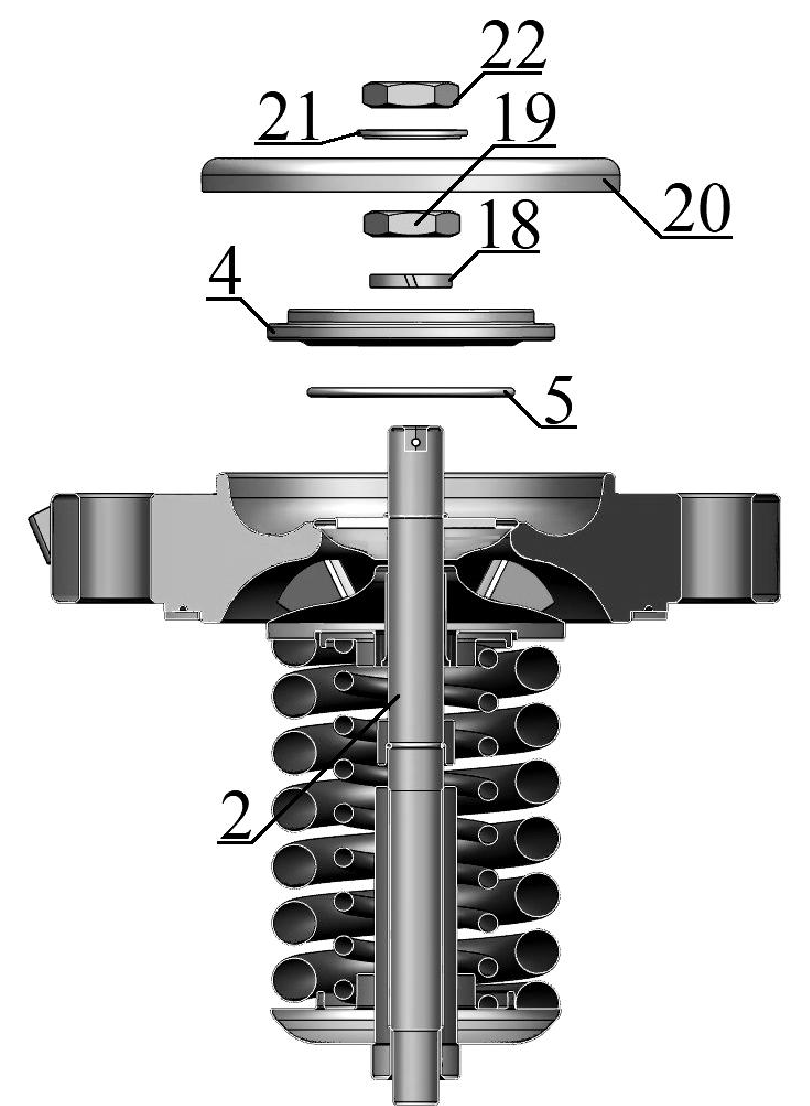
Disc seal and retaining components — Figure 2 from the operating manual
Operating manual
| 09.267-0000РЭ | 09267 safety valve operating manual | Open | Unknown |
Certificates
| 26.04.01.03818.130 | Type Approval Certificate | Open | Unknown |
Frequently asked questions
Answers to questions about selecting, connecting and operating the product.
What is the 09267 valve designed for?
This is a dedicated version for LPG tank containers, set to 18 bar. It is not intended for road tanker installation.
How does 09267 differ from 09268?
09267 is a relief valve set to 18 bar for LPG tank containers. 09268 is a safety device set to 22 bar for ammonia tank containers, combining a valve and a bursting disc. These are different versions: nominal bore alone is not sufficient to select a replacement.
Does the valve need external power?
No. The spring-loaded valve acts directly under the pressure of the working medium and requires neither electrical power nor external control.
Is PN 38.5 bar the activation pressure?
No. This version is set to 18 bar. PN is the nominal pressure rating; 57.75 bar is the body test pressure.