Error
текст ошибки


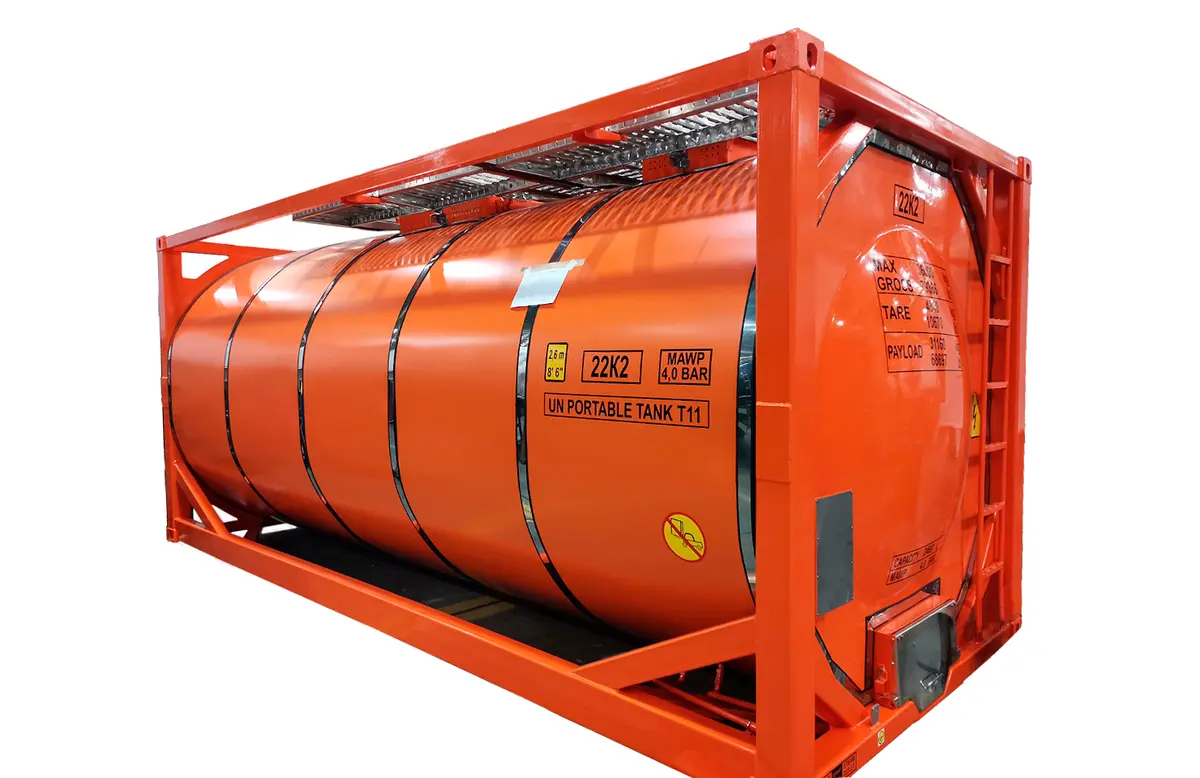
Tank container C11L26RS
C11L26RS is a 26,000-litre T11 tank container in the 20-foot 1CC size for liquid cargo transport. The vessel is made of 1.4402 steel; suitability for a particular product depends on its properties and the container documentation.
About the product
- TypeT11
- Volume26,000 l
- Dimensions to ISO 668:2020, 1CC (20 ft)6058x2438x2591 mm
- Tank container tare weight3700 kg; -01RS version — 4200 kg
- Maximum gross weight36000 kg
- Maximum payload32300 kg
- Internal design pressure, MPa0.4
- Test pressure, MPa0.6
- Operating temperature range-40℃ ... +50℃
- ApplicationNon-hazardous liquids and dangerous goods of classes 3, 5, 6, 8 and 9
- ManufacturerSespel
- Материал цистерны1.4402 SANS 50028-7
Contact us for more information about this product.
 Tank container C11L26RS
Error
Description
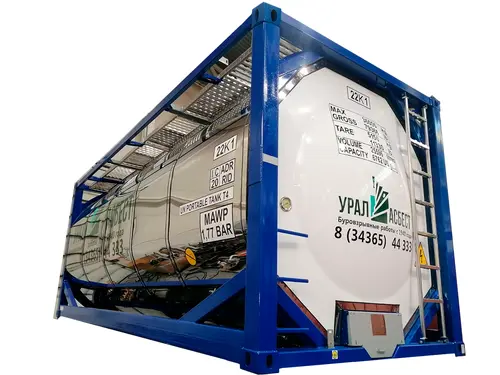
C11L26RS is a 26,000-litre T11 tank container with a bottom outlet and a separate top loading and unloading assembly. This layout allows connection to different liquid receipt and discharge arrangements. The 1.4402 steel vessel is mounted in a twenty-foot 1CC frame for road, rail and sea transport.
Suitability for a particular cargo depends on product properties, material compatibility and the documentation supplied with the tank container. A T11 designation and hazard class do not replace checks of transport conditions, concentration, temperature and seals. The basic C11L26RS and insulated C11L26-01RS have the same capacity but different equipment and tare weights.
Two discharge paths: bottom outlet and top siphon line
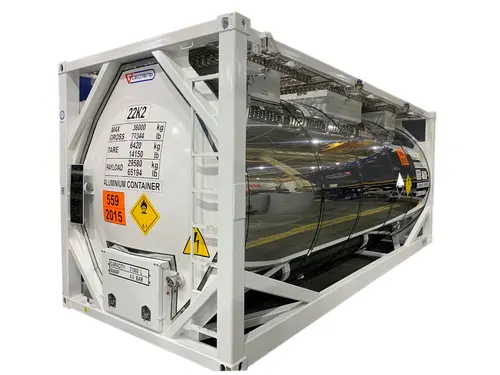
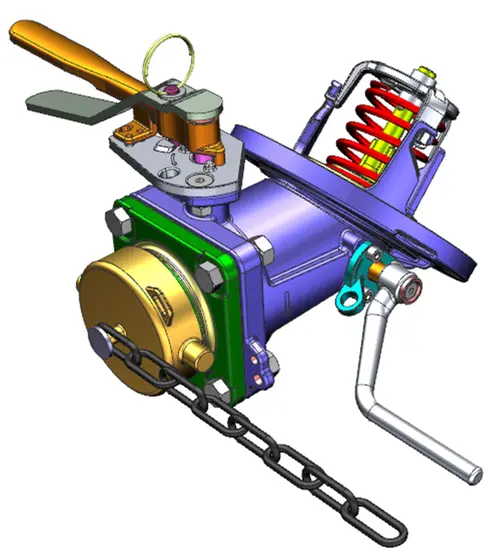
The bottom outlet assembly is housed in an equipment compartment at the lower rear of the container. The compartment protects the fittings from external impacts and provides locking and sealing points. The documents describe a three-inch bottom outlet assembly at 30°; the specific connections and version are defined by the specification.
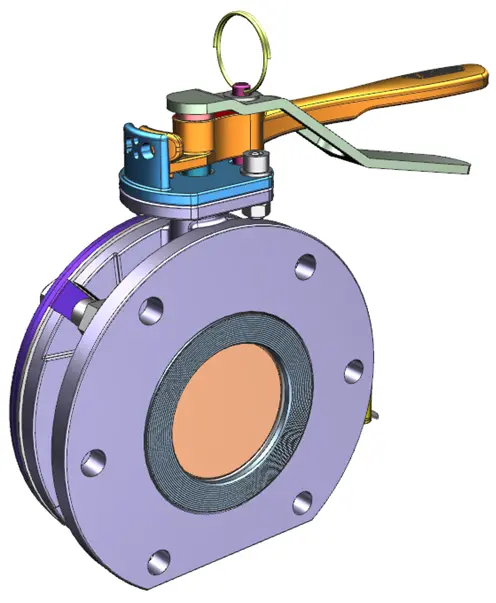
Closed top loading and unloading use a separate product line with a DN80 butterfly valve and siphon tube. The tube connects the top fitting to the lower part of the vessel. The manual and specifications provide for top discharge using an external pump or pressure transfer within the permitted conditions. These are connections to site equipment, not an indication of an onboard pump.
A separate ball valve connects the gas or air line. Its function differs from the liquid line and safety valve. The terminal arrangement, connections and seal materials must be agreed before ordering; multiple discharge paths do not remove limits on pressure or product compatibility.
1.4402 steel vessel and equipment access
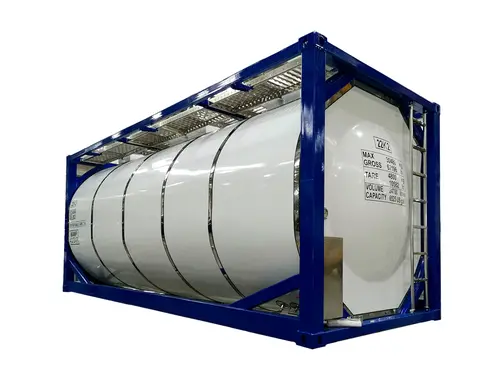
The welded vessel consists of a cylindrical shell and two torispherical heads. The manual specifies 1.4402 steel with a carbon content below 0.03%. The internal surface is cleaned, degreased and chemically passivated, or given a documented coating. Surface and seal condition must be assessed for the cargo being carried.
The end frames connect to the vessel through support rings and to each other through longitudinal beams. Corner fittings are used for handling, securing and stacking. A platform with non-slip decking and a ladder provide access to the top fittings, and the frame has earthing points for transfer operations.
Service manway and safety fittings
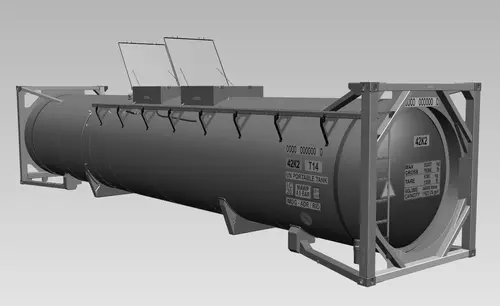
The top equipment is arranged in two covered containment boxes. The central box houses a DN500 manway with eight swing bolts, while the fittings box houses process equipment. The boxes limit the spread of accidentally spilled product over the tank surface. The manway is for inspection, cleaning and repair; the manual prohibits using it in place of the transfer line.
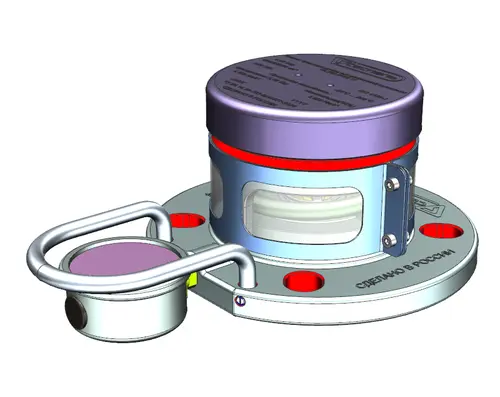
The manual describes a DN65 spring-loaded pressure/vacuum relief valve with a flameproof gauze and a rupture-disc assembly with disc-integrity monitoring. The product and gas line shut-off fittings serve different purposes. Safety assembly equipment and settings must be verified against the individual container passport and the documentation for the installed fittings.
C11L26RS and C11L26-01RS: what changes
The basic C11L26RS has a specified tare weight of 3,700 kg. The C11L26-01RS version has a tare weight of 4,200 kg, 50 mm insulation and a steam jacket. Basalt-mat insulation is protected from moisture by external cladding. These features belong to the -01RS version and are not claimed as standard on the basic container.
In the -01RS version, the steam jacket transfers heat to the product through the vessel wall. The manual specifies a heating area of up to 10 m² and a steam-system working pressure of 0.6 MPa. This is a separate circuit whose parameters must not be equated with vessel pressure. A thermometer on the rear end monitors cargo temperature. Heating requires an external heat-transfer medium supply.
Main parameters and load selection
- Geometric capacity26,000 litres
- Vessel material1.4402 steel
- 1CC dimensions6,058 × 2,438 × 2,591 mm
- Basic C11L26RS tare weight3,700 kg
- C11L26-01RS tare weight4,200 kg
- Maximum gross weight36,000 kg
- Design internal pressure0.4 MPa
- Test pressure0.6 MPa (6 bar)
The stated 26,000 litres is geometric volume, not authorisation to fill the tank completely with any product. Loading must account for density, thermal expansion, permitted filling ratio and gross mass. The insulated version weighs 500 kg more, so its permissible cargo mass must be calculated separately under the same gross-mass limit.
The ambient operating range is −40 to +50 °C. Permissible cargo temperature depends on the version and product documentation. A steam jacket does not mean every cargo may be heated to the equipment temperature limit; the conditions must be selected for the substance and supplied configuration.
Manual and specifications for both versions
| C11L26RS-0000 РЭ | C11L26RS and C11L26-01RS operating manual | Open | Unknown |
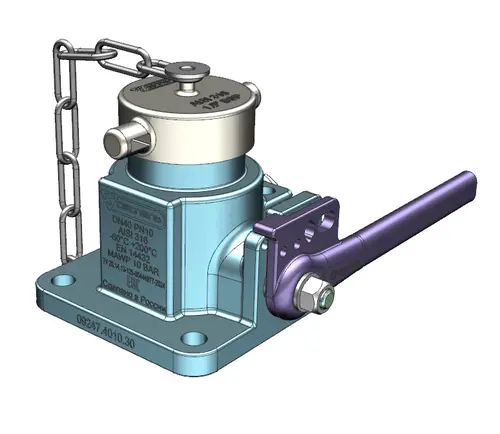
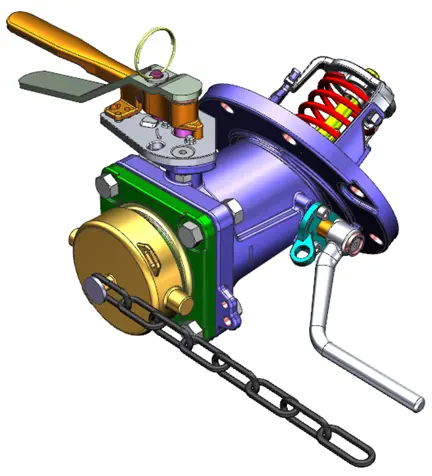
Compatible fittings
Frequently asked questions
Answers to questions about selecting and configuring a tank container.
What is C11L26RS designed for?
C11L26RS is a 26,000-litre T11 tank container in the 20-foot 1CC size for liquid cargo transport. The vessel is made of 1.4402 steel; suitability for a particular product depends on its properties and the container documentation.
Standard and insulated versions: what matters?
The manual distinguishes C11L26RS from C11L26-01RS. The standard version has a specified tare of 3700 kg; the -01RS version has a tare of 4200 kg. The 50 mm insulation and heating system belong to the -01RS version and must be specified separately in the order.
Loading and unloading equipment: what should be checked before ordering?
The design includes closed top loading with a siphon pipe, a bottom discharge assembly and a gas line. A ladder and platform provide access to the top equipment. Connections and seal materials are selected for the product and site equipment.
Can the load be determined from capacity alone?
No. Product density and condition, permitted filling level and the individual container gross weight must be checked. Geometric capacity describes vessel volume, not a universal cargo mass.