Error
текст ошибки


Mobile energy storage system
A mobile energy storage system is a battery installation that can be placed near consumers or transported to locations with insufficient fixed power infrastructure. The containerized ESS described here uses sodium-ion (Na⁺) cells, has a stated total energy capacity of 1.6 MWh and is designed to fit within the dimensions of a 20-foot container.
About the product
- Total energy capacity1.6 MWh
- Nominal system voltage957 V
- Nominal charge/discharge current850 A
- Maximum charge/discharge current1,700 A
- Stated system cycle life8,000 cycles
- Discharge temperature range−40 to +60 °C
- Number of racks10
- Number of modules70
- Enclosure format20-foot container
Contact us for more information about this product.
Mobile energy storage systemError
Description
A mobile energy storage system is a battery installation that can be placed near consumers or transported to locations with insufficient fixed power infrastructure. The containerized ESS described here uses sodium-ion (Na⁺) cells, has a stated total energy capacity of 1.6 MWh and is designed to fit within the dimensions of a 20-foot container.
What is a mobile ESS?
An ESS (Energy Storage System) stores electrical energy and delivers it when required. In a mobile configuration, battery racks are housed in a transportable module, making temporary, backup or local power supply possible without building a permanent battery-storage facility.
Two distinct specifications matter: energy capacity (kWh or MWh) is the amount of stored energy, while power (kW or MW) indicates how quickly the system can supply it. An energy capacity of 1.6 MWh must not be mistaken for a 1.6 MW output rating; converter specifications and the available load power have to be established separately.
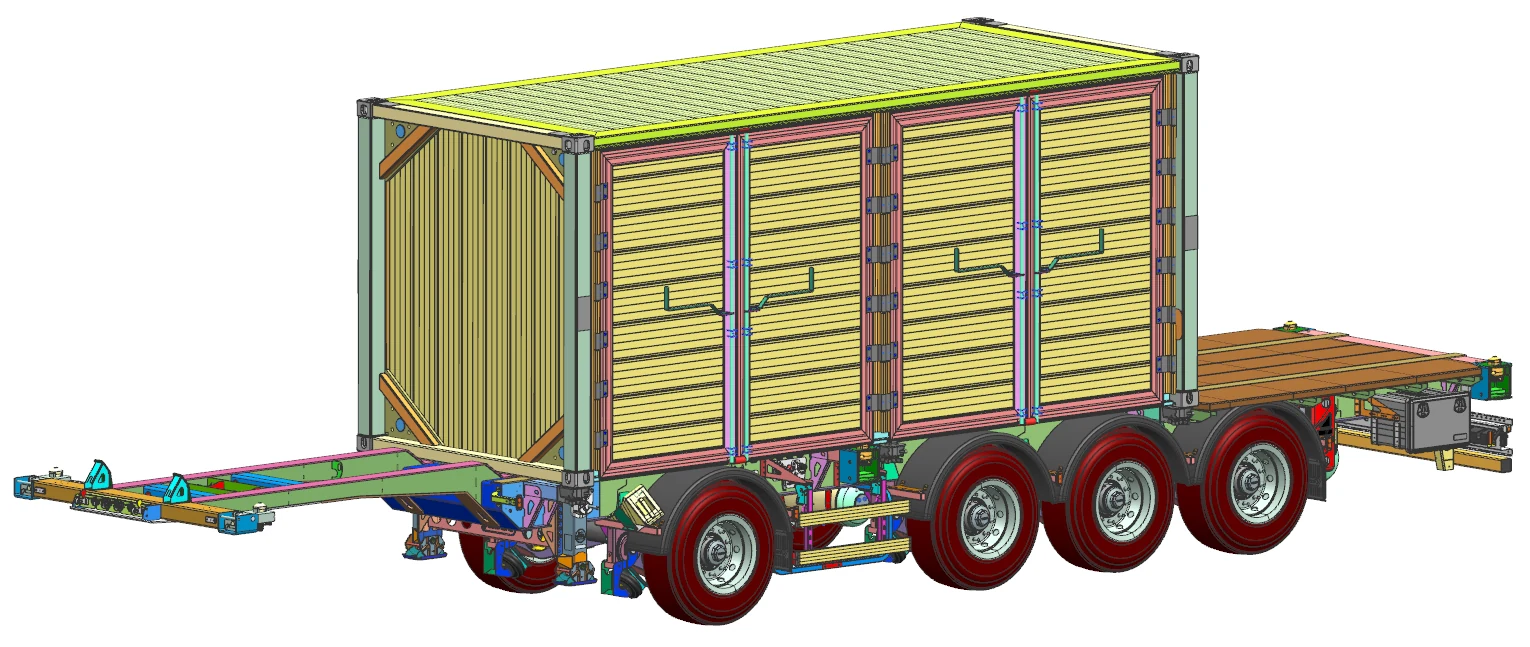
3D model of a mobile configuration: a containerized ESS on a transport chassis.
Sodium-ion batteries: cell specifications
The system uses a sodium-ion (Na⁺) cell with a nominal capacity of 170 Ah. At a nominal voltage of 2.85 V, its nominal energy is 484.5 Wh. The stated cycle life is at least 8,000 cycles; test conditions and remaining capacity at end of life have not been specified.
| Cell specification | Stated value |
|---|---|
| Nominal capacity | 170 Ah |
| Nominal energy | 484.5 Wh |
| Specific energy | 105 Wh/kg |
| Operating voltage range | 1.5–3.5 V |
| Nominal voltage | 2.85 V |
| Internal resistance (1 kHz) | ≤ 0.3 mΩ |
| Discharge temperature | −40 to +60 °C |
| Charge temperature | 0 to +55 °C |
| Dimensions | 72 × 174.6 × 207 mm |
| Weight | ≤ 5 kg |
| Stated cycle life | ≥ 8,000 cycles |
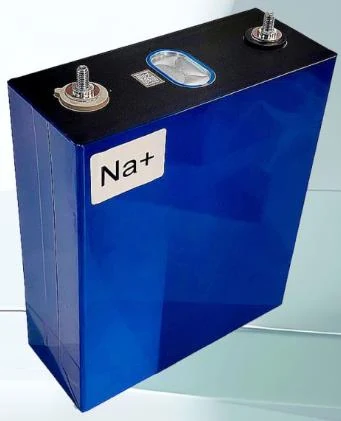
Prismatic sodium-ion (Na⁺) battery cell.
Charging and discharging have different temperature limits. Discharge operation at −40 °C does not mean charging is permitted at that temperature: the specified charging temperature range for this cell starts at 0 °C.
Why use sodium-ion chemistry?
Sodium-ion technology offers widely available sodium-based raw materials, the ability to discharge at low temperatures, a stated long cycle life, and potential benefits in safety and recycling. These properties make it relevant to energy storage, electric industrial machinery and transport.
The cost of a complete ESS cannot be determined from raw-material prices alone: it also includes modules, electronics, converters, the enclosure, safety systems, installation and maintenance. Safety and lifetime claims likewise require verification for the specific battery and operating conditions.
- Low-temperature discharge: the cell is specified for −40 to +60 °C.
- Stated cycle life: at least 8,000 cycles, with no test methodology supplied.
- Sodium feedstock: potential to reduce dependence on certain expensive materials.
- ESS use: emphasis on stored energy, cycling requirements and operating conditions, not energy density alone.
20-foot container module design
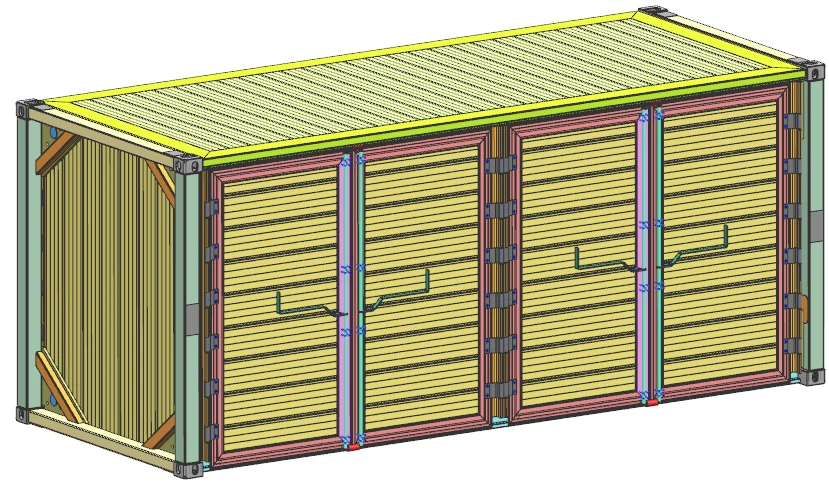
The container module is designed for standard 20-foot dimensions. Its frame uses end structures and lightweight extruded aluminium profiles. This configuration is intended to support conventional container transport logistics.
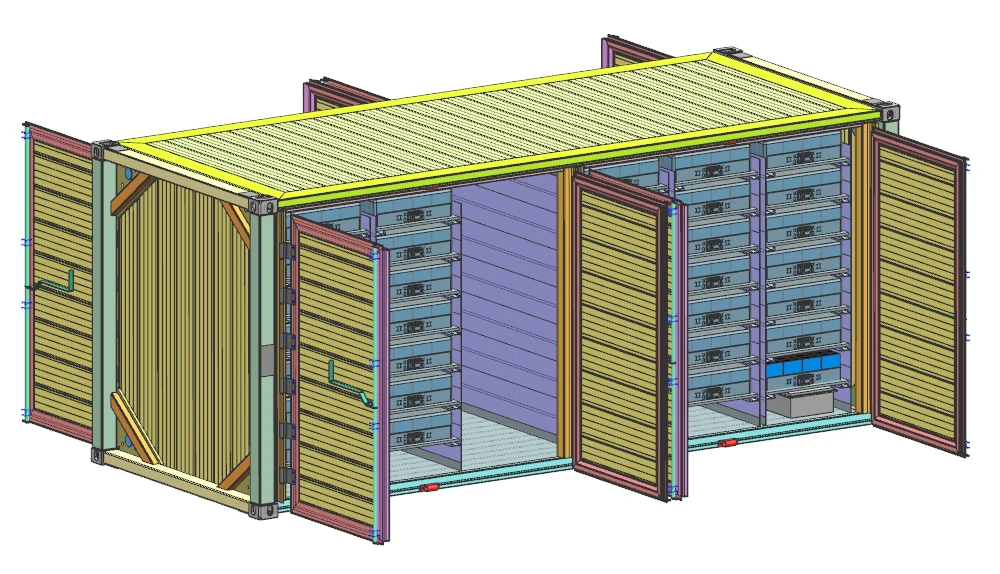
Full-length hinged side doors provide access to battery racks for inspection and servicing. The sealed enclosure is described as having climate control and automatic fire suppression. Their configuration and maintenance requirements must be confirmed in the detailed project documentation.
The design solutions are stated to be protected by Russian patents. Patent numbers are not specified, so the scope of protection should be checked against the patent documents.
External configuration of the 20-foot storage unit with side service doors.
Battery-rack access through hinged doors along the container.
Specifications of the 1.6 MWh container system
The following technical specifications are stated for this containerized system. They describe this particular configuration rather than all sodium-ion ESS solutions.
| ESS specification | Value |
|---|---|
| Total energy capacity | 1.6 MWh |
| Nominal system voltage | 957 V |
| Nominal charge/discharge current | 850 A |
| Maximum charge/discharge current | 1,700 A |
| Stated system cycle life | 8,000 cycles |
| Discharge temperature range | −40 to +60 °C |
| Number of racks | 10 |
| Number of modules | 70 |
| Enclosure format | 20-foot container |
Engineering selection also requires usable delivered energy capacity accounting for BMS limits, AC output power, converter specifications, charging time and connection interfaces. These parameters must be established before choosing the system.
Where mobile energy storage can be used
Mobile energy storage systems can be used in transport logistics, industrial facilities, agriculture, ports, quarries and for charging electric vehicles at remote sites. In each case, the container acts as a transportable energy reserve; the charging setup, load power and operating autonomy depend on the site.
| Sector | Potential application |
|---|---|
| Fleet depots | Mobile charging for electric vans, trucks and buses. |
| Small factories and workshops | Backup electricity for equipment and production lines. |
| Agriculture | Charging electric tractors and harvesters during field work. |
| Ports and marine logistics | Charging electric boats and small ferries at a berth. |
| Quarry equipment | Power supply for electric haul trucks and loaders at remote sites. |
| Tourism and outdoor recreation | Mobile charging for electric motorcycles, ATVs and similar vehicles. |
These are potential use cases, not confirmed implementations at specific facilities.
What to check when selecting and deploying an ESS
Project design starts with the load profile: peak and average demand, required runtime without grid power, cycling frequency and available charging power. Engineers then specify power conversion, the battery management system (BMS), protection, switching and site interfaces.
Mobile use also requires attention to securing the container on its chassis, transport conditions, grounding, service access and site fire safety. Thermal management must maintain acceptable charging temperatures even if the battery can discharge in very cold weather.
- Confirm usable capacity, available power and runtime at the specified load.
- Match the grid or charging source, converter and connected loads.
- Check temperature requirements for charging, discharging and storage.
- Request cycle-life and safety test evidence and details of protective systems.
- Establish procedures for transport, installation, connection and on-site maintenance.
Sources
- Sespel. “Mobile Energy Accumulation and Storage Systems.” Presentation, Cheboksary, 2026, slides 1–5.
- Numerical specifications and 3D illustrations are taken from the presentation; selection guidance explains the additional engineering data required for an actual project.
Frequently asked questions
Answers to questions about selecting, connecting and operating the product.
How does a battery system differ from a generator?
An ESS supplies stored electricity and needs recharging; a generator produces electricity from another energy source.
Can the system charge at −40 °C?
Not on the basis of the stated cell data: −40 °C is a discharge limit, while charging starts at 0 °C.
How many hours will a 1.6 MWh system operate?
Runtime depends on load power, usable energy capacity and conversion losses. These values are needed for an accurate estimate.
What does an 8,000-cycle rating mean?
The stated cycle life for this system is 8,000 cycles. Estimating service life also requires depth of discharge, temperature, charging rate and end-of-life criteria.