
RUPLASTICA 2025: Politekhnika presents an innovative silo
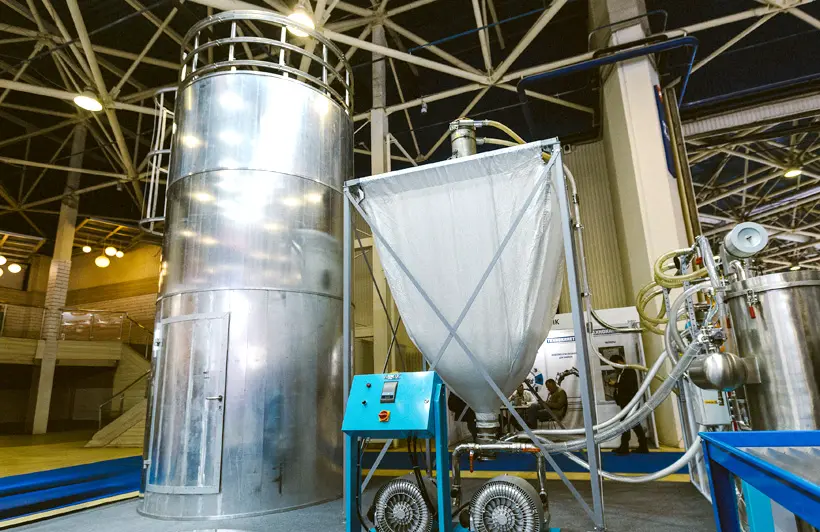
The world’s first silo made from extruded AlMg3 aluminium-magnesium profiles was developed and manufactured in Russia using a patented friction stir welding process. Designed for safe storage of any polymer raw material, it offers greater strength than sheet-aluminium alternatives and can accommodate virtually any additional equipment or sensors. The innovative silos are manufactured by Sespel in Cheboksary, Russia.
At RUPLASTICA 2025 in Moscow, engineering company Politekhnika presented a 20 m³ prototype from a broad equipment range with gross volumes from 26 to 277 m³, diameters from 2.4 to 4 m and heights from 7.6 to 27 m.
“These innovative silos are made from curved, box-section aluminium profiles with 6 mm walls. The profiles interlock and are automatically joined using a distinctive patented process: friction stir welding (FSW). The shell sections are welded in the same way, completely eliminating incomplete fusion,” explained Alexander Mashinistov, CEO of Politekhnika, Sespel’s exclusive dealer for storage equipment serving the polymer industry.
The company notes that this manufacturing approach makes the silo so strong and reliable that it can be used in earthquake-prone areas. It also retains the familiar advantages of aluminium profiles: a lightweight, strong structure that resists corrosion and vacuum collapse and can store raw materials, including those used in the food industry. The manufacturer specifies a service life of at least 50 years.
“We expect strong demand for several reasons. First, Sespel silos are included in a government support programme funded by the Industrial Development Fund. Second, extensive automation allows Sespel to manufacture a unit of any capacity within one to two months,” Alexander Mashinistov explained.
The company states that delivery, from placing the production order to commissioning, takes three to four months. This includes preparing a full technical specification, transport to the installation site, installation of the silo and ancillary equipment, assembly of the automation cabinet and pipework installation.
Sespel silos can be fitted with virtually any additional equipment, including vibrating discharge bottoms, cone air aerators, load-cell weighing systems, pressure relief valves, self-cleaning filters and explosion vent panels. Supported discharge systems include discharge boxes, rotary feeders, screw conveyors and others. Any type of level sensor can be installed: rotary paddle, plumb-bob, ultrasonic, radar or laser. This flexibility allows plastics processors to customise the equipment for virtually any polymer production facility.